Ironton and Lawrence County
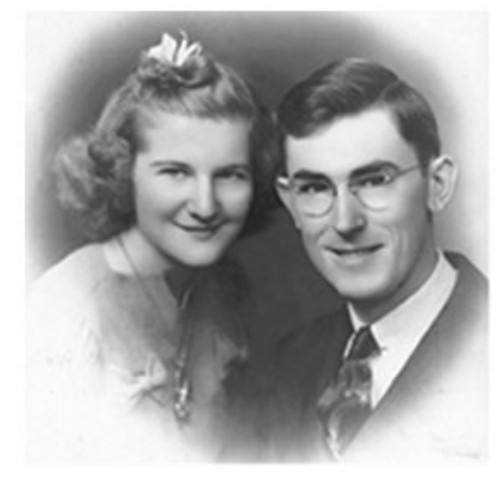
Albert Junior Schweickart and Mary Eleanor Howell grew up in the southern Ohio world described across the family books. Their son John’s biography follows schools, relatives, early jobs, recreation, and the disruptions that shaped their lives. John brings together his memories of his parents with photographs, correspondence, and other family documents.[1]
Albert’s early work included machinery repair in the region’s industrial plants. The biography describes the conditions he remembered in a steel mill and a carbon-products factory. Its account of the January 1937 Ohio River flood includes the isolation of Ironton and a family story about his brother Lowell using heavy equipment to cut a temporary route through the hills. John records that route story among the recollections of Albert’s early life.[2]
A household begins
John recounts Albert meeting Eleanor at a tennis court Albert had built. Their marriage is recorded on December 23, 1939, at the First Methodist Church in Ironton. The early married years connect their home life with Albert’s work, correspondence study, and movement into construction surveying. Surveying and construction became an increasingly important part of Albert’s work before he entered the Army.[3]
Two wartime experiences
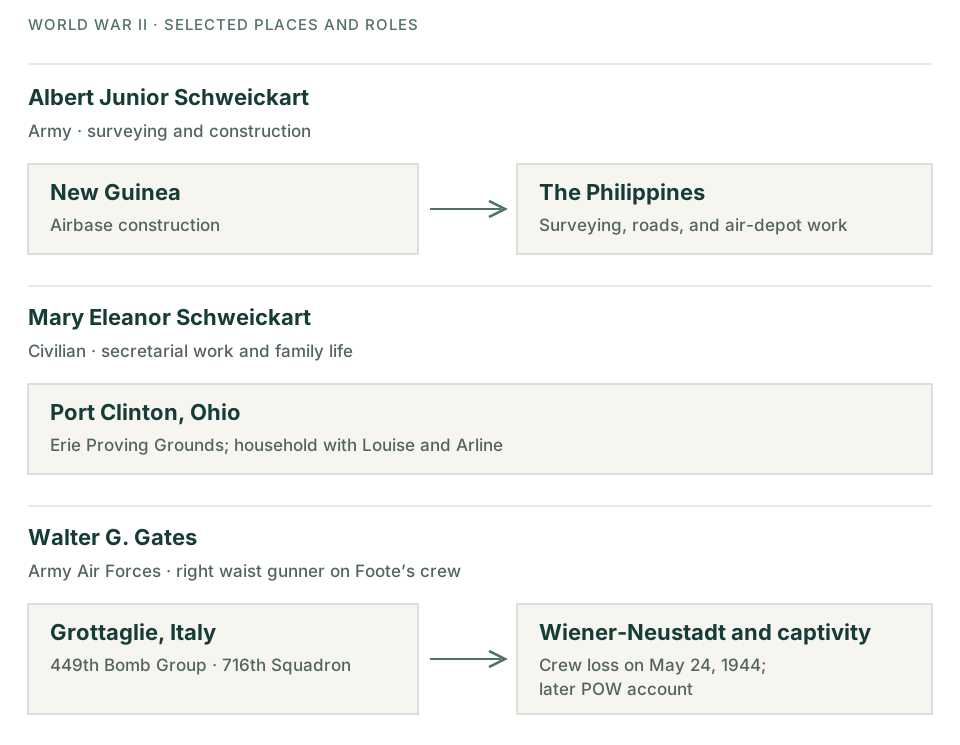
Albert Junior Schweickart
New Guinea → the Philippines. Army surveying and construction, including airbase, road, and air-depot work.
Mary Eleanor Schweickart
Port Clinton, Ohio. Civilian secretarial work at Erie Proving Grounds; household with Louise and Arline.
Walter G. Gates
Grottaglie, Italy → crew loss over Wiener-Neustadt and captivity. Army Air Forces right waist gunner, 449th Bomb Group, 716th Squadron.
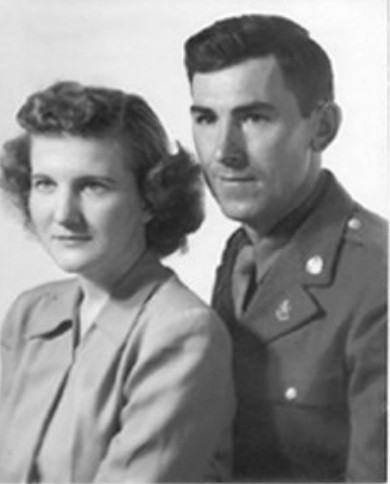
The war separated their daily lives. Albert’s chapter follows Army surveying, road and air-depot construction, and service in New Guinea and the Philippines. The book reproduces material about a proposed field commission and describes the shrapnel injury at Tacloban for which he received a Purple Heart. John includes the recommendation and the family’s record of Albert’s service alongside his recollections.[4]
Eleanor’s wartime chapter has its own substance. It follows her move to Port Clinton, where her mother Louise was working at Erie Proving Grounds. Eleanor worked there as a secretary and lived with Louise and her sister Arline. The account describes shared household expenses and the effort of maintaining family ties during the separation. Her base identification card uses the name Mary E. Schweickart, and the chapter follows the household she shared with her mother and sister.[5]
From Ohio to Michigan
The postwar chapters follow a transition through work and housing. The biography records Albert beginning plant-engineering work in Detroit in 1947. It describes construction estimates, drawings, materials, scheduling, outside contractors, and maintenance planning. Around 1950, he moved to construction-estimating work at Ford, and the family built its Allen Park home.[6]
The home and family life that followed are part of the same story as the job changes. The book continues through childhood, school, holidays, retirement, and later years. The Allen Park home became the setting for John and Brian’s childhood and for the family gatherings preserved in the later photographs.