Buck Creek
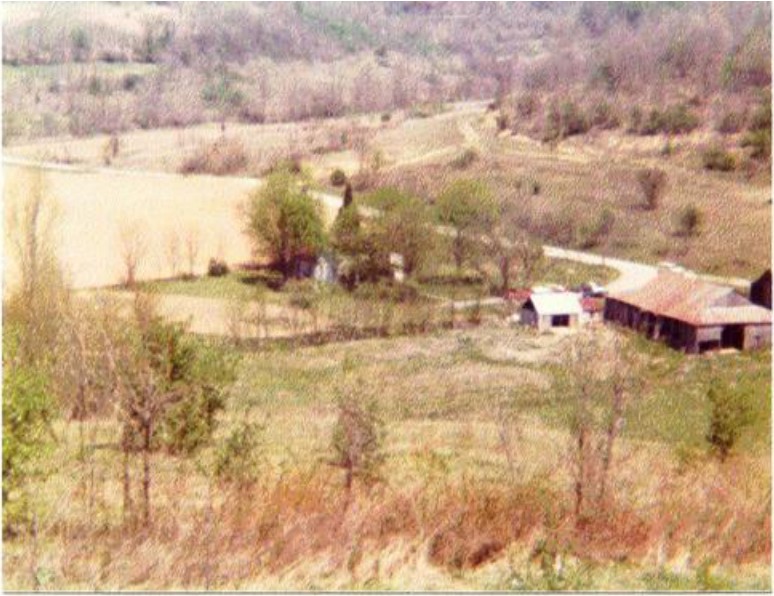
Charles Allen Wiseman and Martha Jane Stewart’s home was a hilltop farm along Buck Creek in Mason Township, Lawrence County, Ohio. Their daughter Louise’s family connects this place with the Howell and Schweickart records. The farm book brings together biography, family photographs, drawings, letters, recollections, and records of objects that survived in the family.[1]
A place that can be reconstructed
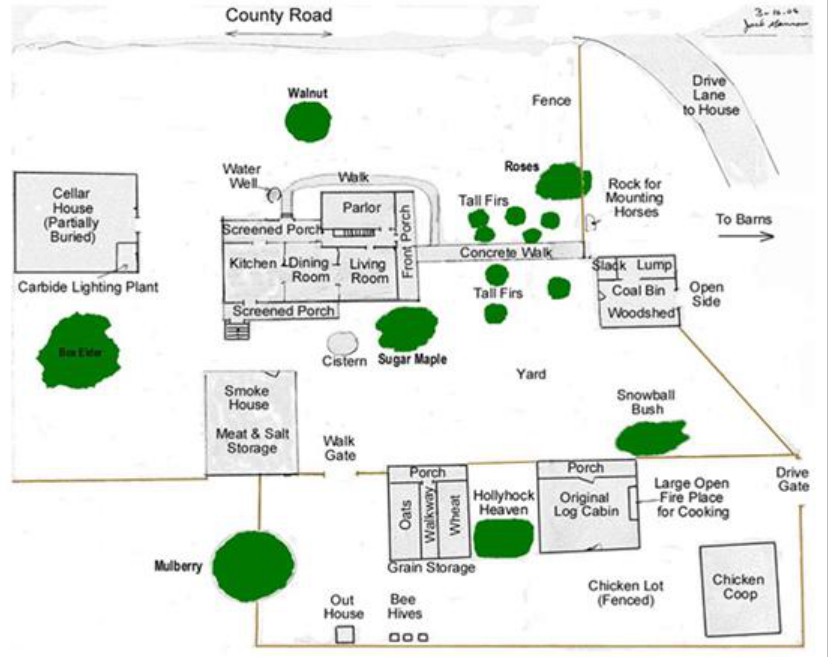
The recollections describe how the buildings and the work fitted together. The account describes the two-story main house, built in 1875, with a kitchen hand pump and a screened porch. A cellar, smokehouse, grain storage, chicken houses, barns, and other buildings each had a purpose. Jack Mannon’s west-side layout records their relationship to the house, paths, water, trees, and work areas.[2]
Work and the household economy
The account describes wheat and corn grown for sale, along with orchards, sheep, hogs, dairy cattle, poultry, horses, and mules. Food, income, and the care of animals were connected. Harvesting also involved neighboring families sharing work and equipment. Neighboring families worked together at harvest time, sharing labor and equipment.[3]
The women’s work is recorded as part of that operation: maintaining the vegetable garden, carrying water from the creek, preparing food, preserving it, and sustaining the household. The account places those tasks alongside tending livestock, fieldwork, and the seasonal demands of the farm.[3]
More than one person’s memory
Several contributors give the place depth. Olive Ruth Irish’s recollections describe childhood in a large household. Her account of Martha’s death records the loss within the family. Phyllis Mannon’s “Do You Remember” letters return to childhood experiences decades later. Alan “Jack” Mannon’s memories and drawings give another view of the house and farm.[4]
In her letters to Ruth, Phyllis returned to scenes from their childhood on the farm. John places the series broadly from the late 1970s into the early 1990s, noting that most letters were undated. The exchange carries those shared memories into a later stage of the sisters’ lives.[4]
Christmas memories from the Wiseman farm, on Schweickart Media →
What survives
The collection also records a pocket watch, a coffee grinder, a dry sink, family graves, the chapel, and later views of the property. The pocket watch and household pieces are recorded with their later family owners; photographs return to the farm, chapel, and gravesites.[5]